Rework and the non-conformity lifecycle, end to end
How Flexireo coordinates rework and the full non-conformity lifecycle: from blocked SKU to ESPR documentation
Flexireo runs the apparel and footwear non-conformity process as a structured seven-stage lifecycle. Stages two through four are a complete rework-partner workflow - sourcing, RFQ, and award - and whether a batch is routed for rework, donation, or recycling, every partner provides the evidence needed for an ESPR audit trail your sustainability lead will eventually have to present. Stop the inbox archaeology and replace it with a specialized QMS that processes every disposition route in a single source of truth.
One score · Five paths · One audit trail
Stage 1: Triage and recoverability scoring
Every non-conformity batch enters Flexireo at triage. From the moment of intake, two outputs run in parallel: a recommended disposition for the batch, and the first entry in its Article 24 audit trail.
The Recoverability Score helps you determine the optimal route based on economic, technical, and regulatory factors. The composite, from 0 to 100, recommends one of six paths: rework, prep for reuse, donation, recycling, other recovery, or disposal.
The audit-trail entry opens at the same moment, and every status change, photo, and operator confirmation from this point forward attaches to it.
- Capture the blocked batch at intake: SKU list, quantity, and defect type.
- Score the batch to determine the optimal route: rework, reuse, donation, or recycling.
- Open the unit-level audit-trail entry immediately, regardless of final disposition.
- Donations, recycling, and scrap roll into your Article 24 disclosure with the same chain of custody as reworked units.
- Triage stops being an art and disclosure stops being a year-end scramble.
Route assignment · Rework partner sourcing
Stage 2: Routing and rework partner sourcing
Routing a batch to a disposal plant or donation center is a direct flow in Flexireo. But if the triage recommends rework, the platform initiates a specialized partner selection process.
Flexireo matches the job to external workshops with the right capacity, capability, and historical scorecard for the specific defect. Sourcing stops being institutional memory and starts being structured data.
- Direct routing for disposal, donation, or recycling recipients.
- For rework, filter the partner network by capability tags (stitching, finishing, leather repair).
- Surface workshops with available capacity inside your target window.
- Layer historical data on top: on-time rate, defect rate, and previous responsiveness.
Structured RFQ · Side-by-side
Stage 3: RFQ and bid comparison
For rework projects, a RFQ is sent to multiple partners at once. Each workshop sees the same defect taxonomy, acceptance criteria, and ESPR-ready documentation requirements.
Bids return in a comparable format, allowing you to compare quotes that share a common structure. This is how you reclaim the week per project usually lost to spreadsheet wrangling.
- Generate RFQs from templates tuned to your specific defect types.
- Send to multiple workshops simultaneously with built-in acknowledgment tracking.
- Compare side by side on price, lead time, and the workshop's historical quality scorecard.
Award · Chain of custody
Stage 4: Project award and onboarding
When you award the batch - whether to a rework workshop, a donation center, or a disposal plant - Flexireo triggers the operational handoff. The chain-of-custody log opens, document sharing kicks in, and the partner is notified.
Every partner type receives role-based access to provide the status updates and evidence your ESPR report will require.
- Award the batch to one or more partners.
- Capture the awarded price against the batch, so the cost of the work stays with it whichever partner type takes it on.
- Auto-generate the chain-of-custody log and intake checklists.
- Share document and photo references immediately with the selected recipients.
- Notify logistics and sustainability teams of the award and the projected timeline.
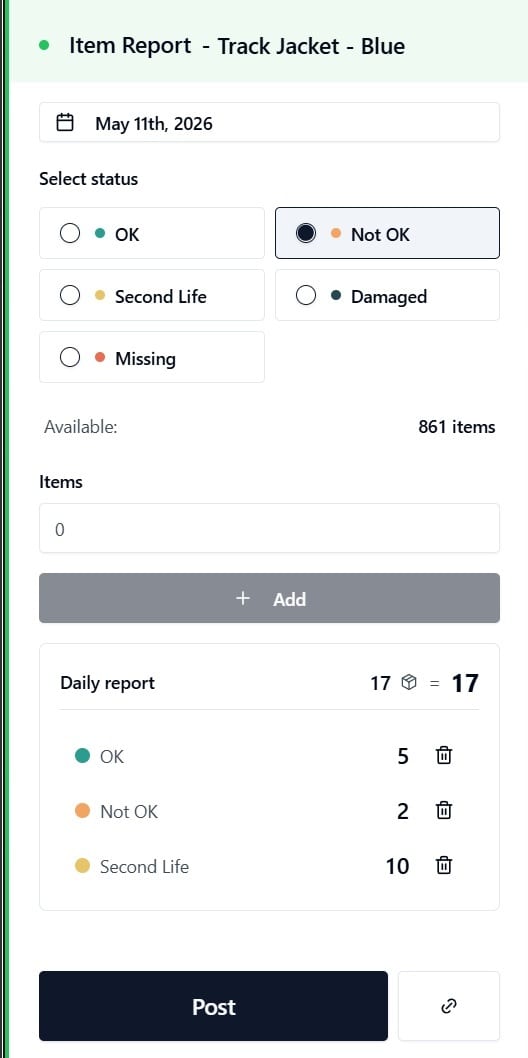
Unit-level visibility · AI briefings
Stage 5: Execution tracking with evidence
During execution, partners log status changes and upload photo evidence directly from the workshop or facility floor. Your team watches the operation in real-time, but you don't have to spend your day digging for data. Overnight, our AI reviews your global operations and emails a single briefing to your inbox, flagging anomalies or delays before they grow into crises.
- Mobile-first status reporting for every unit and every partner type.
- Photo evidence attaches to exceptions and finished units.
- Time stamps and operator identifiers captured on every status change.
- A daily carrying cost you set applies on any route, for as long as the batch stays open, so elapsed time reads as money, not just days.
- Daily AI briefings roll up the operation - the next morning's update writes itself.
Article 24 · Out of the box
Stage 6: ESPR-ready documentation generation
The data captured across every route maps directly to the five Article 24 disclosure fields. Because every partner - from donation centers to recyclers - provides evidence in the platform.
Your required reports are populated as a byproduct of running your operations, and you get audit-grade documentation exported in the format the regulation expects, with no separate compliance system required.
- Article 24 disclosure fields auto-populate from daily execution data.
- Partner confirmations captured with timestamps and digital evidence.
- Derogation references attach to disposal routes per Delegated Regulation C(2026) 659.
- Standardized exports ready for sustainability audits or public disclosure.
Vendor scorecards · Performance data
Stage 7: Vendor scoring and re-evaluation
After every job, the partner scorecard is updated based on hard as well as soft data: quality rates, lead-time accuracy, and responsiveness. Your next routing decision is informed by performance history, not by who you remember liking.
This data-driven approach ensures that high performers get more work while underperforming partners get structured improvement plans.
- Quality Score: tracked through first-pass defect rates and re-rework requirements.
- Reliability: actual delivery dates vs. original commitments.
- Responsiveness: time-to-bid and ease of collaboration.
- Cost: what the partner has cost you across the batches they have handled.
- Data informs every future routing and sourcing decision within your QMS.
Alongside the seven stages: what the batch cost
Cost does not land at one stage. It accrues from the moment a batch opens until the moment it closes, whichever route it takes, and four separate pieces of it come out of the stages above.
- ✓The awarded work. The price you award for the job - through the RFQ when the batch goes to a rework workshop, and recorded on the batch directly when it is routed to reuse, donation, recycling, or disposal.
- ✓Carrying cost. A daily rate you set yourself, applied automatically for every day the batch stays open and unsellable, on any route.
- ✓Cost by partner. What each partner has cost you across the batches they have handled, whether that partner is a rework workshop, a recycler, a waste-treatment operator, or a donation channel.
- ✓Transport. Shipping out to the partner and back, and the onward leg to a reuse, donation, recycling, or disposal partner where that is the route.
The four roll up into one auditable total per batch, broken down by category. When someone asks what the failed batch cost, the answer comes out of the operational record instead of being reconstructed at the end of the quarter.
Frequently asked questions
See rework and your full non-conformity lifecycle on one screen
Book a 30-minute demo to walk through the seven stages. We will map your current workflow, identify the bottlenecks costing your team hours every week, show you how your rework projects would run, and show you exactly how your ESPR audit trail would look on real data.