Build journal
Two years inside a live rework operation

What two years of co-developing Flexireo inside a live rework operation taught us - and rebuilt the product.
50,000+ products processed · three observations that reshaped the platform · one-week deployment.
The numbers behind the engagement
Flexireo was built inside a live rework operation, not at a whiteboard. The numbers below summarise two years of continuous operation with a multi-country European sporting goods retailer and a network of subcontracted rework partners.
Three things surprised me, and one of them rebuilt the product
We were working with a multi-country European sporting goods retailer operating across several markets, with a central distribution hub serving the region. The quality team coordinated rework across a network of external workshops the way most apparel and footwear brands still do: spreadsheets they did not fully trust, email threads with attached photos, WhatsApp groups for urgent updates, and a recurring weekly call to reconcile what each system claimed about the same batch of products.
I went in expecting the product Flexireo would become to be roughly the product I had sketched. Two years of co-development changed the shape of the product in three specific ways.
Each surprise that follows came directly from watching a quality manager, a logistics planner, and a workshop operator try to do their jobs across the systems they actually had, not the systems anyone wished they had. Those three observations are the spine of every product decision Flexireo has made since, and they are also what made the platform produce an ESPR-grade audit trail as a byproduct rather than as a feature.
This page lays the three observations out in the order they happened, then describes what changed for the operation, what would have changed if ESPR had already been in force, and how each observation became a feature of the platform you can buy today.
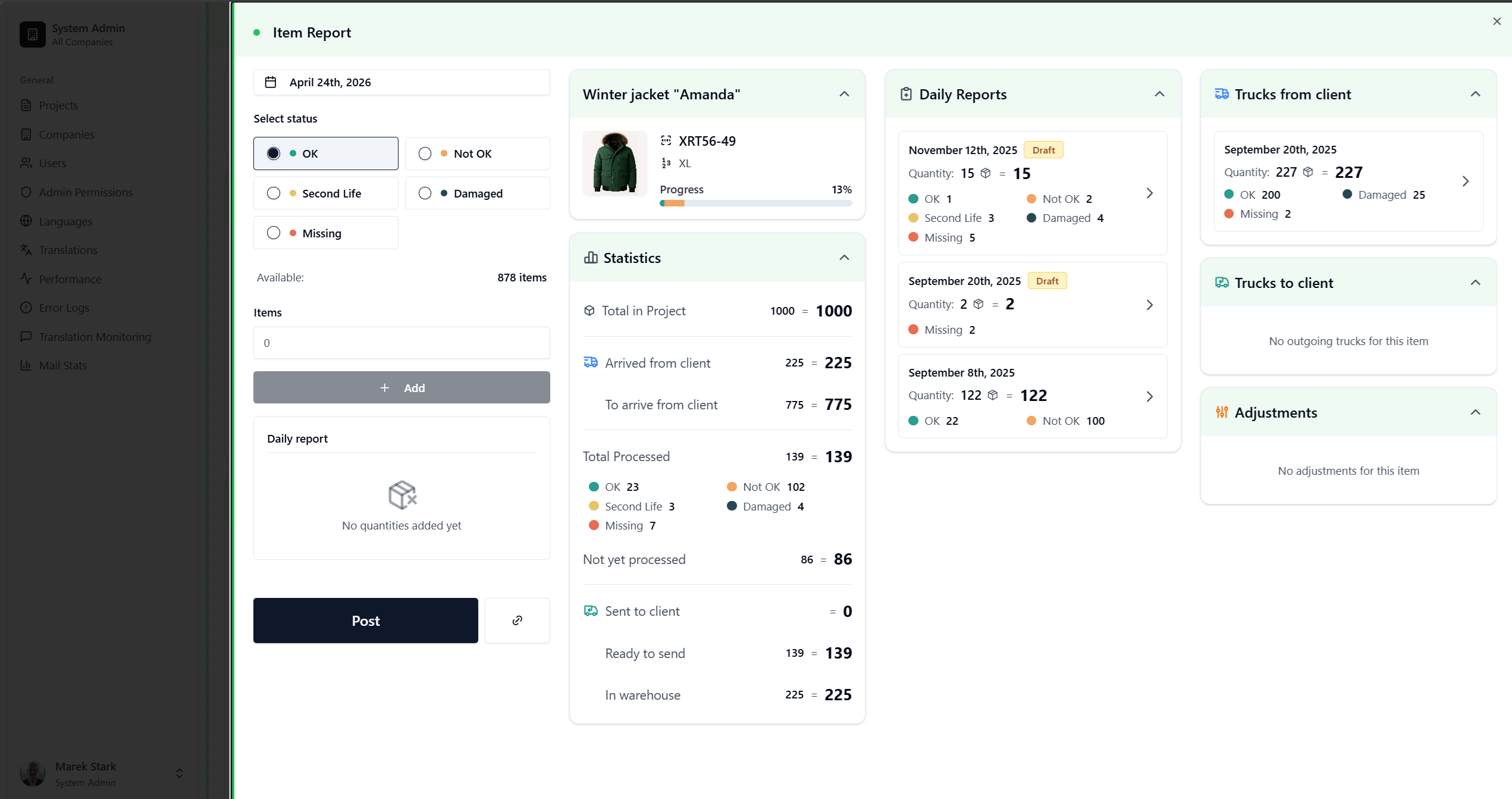
- Daily reports — time-stamped, visible to every party on the project
- One set of statistics; quality, logistics, and the brand all read from this
- Inbound and outbound shipments in the same view as rework status
Insight 1: The unlock was getting everyone on one screen
I went in expecting the win to be process automation. The win turned out to be much simpler: a single screen where the brand, the intermediary, the workshops, and the logistics team all saw the same data, in the same form, at the same time.
Most of the daily operational pain was not workflow design or system logic; it was three people looking at three different spreadsheets and reaching three different conclusions about the same batch of 8000 jackets.
Once everyone moved to one record of one truth, the conversations changed overnight. The Monday morning status call shrank from forty minutes to twelve.
The 'wait, where is the right shipping slip?' question stopped being asked. Decisions that had been held up by data reconciliation started happening in the meeting that surfaced them, because there was nothing left to reconcile.
We did not save the team time by automating processes. We saved it by making data visible.
We did not save the team time by automating processes. We saved it by making data visible.
The hidden labor turned out to be the biggest line item on the operation.
Insight 2: Most of the operational labor was invisible until it disappeared
Before the platform, a quality controller on this account spent roughly two hours of every working day on a task that did not appear in anyone's job description: confirming that things were where they were supposed to be. Was the batch received at the workshop?
Was the photo from yesterday on the shared drive? Was the data in spreadsheet A in line with the data in preadsheet B?
Was the response from the intermediary the latest version or the one from before lunch? Each individual check was small.
Together, they were the job.
When Flexireo made all of that information continuous, time-stamped, and automatic, the controller's day changed shape, not size. The two hours of confirmation labor disappeared, and the hours were absorbed into work that produced more value: vendor scorecard reviews, root-cause analysis on recurring defects, and a real handover between shifts that did not depend on a verbal summary nobody could later cite.
The hidden labor turned out to be the biggest line item on the operation, and nobody had been measuring it.
The retail team noticed the change in availability before the quality team got around to writing it up.
Insight 3: Reworked products do not need to go back through the hub
Every reworked product, by default, was being routed back to the central distribution hub before being sent on to stores. Nobody had designed it that way.
It was simply the only flow the existing systems supported: hub-out and hub-in, with no concept of a third-party workshop as a node in the network. The hub became a bottleneck no one had budgeted for, and the days of dwell time it added to each cycle were measured in lost selling weeks for the most seasonal items.
Once we had unit-level visibility on which store needed which product, the question of why we were doing this became impossible to avoid. Reworked products could now be shipped directly from the workshops to the stores that needed them, cutting days came out of the cycle.
A meaningful portion of the inbound logistics cost could be avoided. The retail team noticed the change in availability before the quality team got around to writing it up.
For the most seasonal items - replica jerseys with sponsor logos, late-season outerwear refreshes, region-specific embellishment runs - the hub-bottleneck removal could be the difference between a product hitting shelves while demand was still present and arriving the week the campaign ended. That reframing changed how we built every feature after.
How those three observations reshaped the product
Each surprise turned into a load-bearing feature. The single-screen observation produced the role-based access model: brand, intermediary, and workshop each see the same record, with permissions matched to their function.
The invisible-labor observation produced the AI nightly briefing: an automated narrative of what changed overnight, written in the language a quality manager would use, so the first hour of the day is spent on judgement rather than reconciliation.
The hub-bottleneck observation unlocked direct-to-retail routing as a first-class disposition path. It also produced unit-level traceability for textiles and footwear, because direct-to-retail only works if you know which unit goes to which store with sufficient precision to satisfy a sales-floor manager who is going to count what arrives.
The audit trail the regulation now requires is the same audit trail the retail team needed two years ago. It turned out one trail satisfies both.
Role-based access
Brand, intermediary, and workshop each see the same record, with permissions matched to their function.
AI nightly briefing
An automated narrative of what changed overnight, so the first hour of the day is judgement, not reconciliation.
Direct-to-retail routing
A first-class disposition path, not an exception. Reworked units can ship straight from workshop to the store that needs them.
Unit-level traceability
Designed for soft goods from the start, not retrofitted from a serialized-parts model.
Workshop scorecard
Updated automatically on weighted KPIs after every batch - vendor performance no longer recalled from memory.
What changed: five before-and-after pairs
Five questions the quality team used to spend real hours on every week. In the platform, each question has a one-click answer. None of these changes required a new headcount; they required the same operation on a different substrate.
| Operational question | Before Flexireo | After Flexireo |
|---|---|---|
| Where is every product right now? | Three people, four spreadsheets, two phone calls | One dashboard, real time, every stakeholder on the same record |
| How do we know the workshop received the right batch? | Manual photo reconciliation via email, often days late | Photo evidence attached to the unit record at intake, time-stamped |
| How do reworked products reach stores? | Back through the central hub, always, adding days of dwell | Option to ship direct from workshop to the store that needs them |
| How do we evaluate vendor performance? | From memory in the annual review meeting | Workshop scorecard updated after every batch |
| What does an auditor see on day one? | An archive of emails, a stack of spreadsheets, several photos | A unit-level chain-of-custody log with operator IDs and time stamps |
What would have changed during these two years if ESPR had already been in force
From 19 July 2026, large apparel and footwear brands placing products on the EU market can no longer destroy unsold textiles, clothing accessories, or footwear listed in Annex VII unless one of ten narrow derogations under Delegated Regulation C(2026) 659 applies. Article 24 of the Ecodesign for Sustainable Products Regulation requires disclosure across five mandated fields, with a ten percent verification threshold against waste-treatment operator records and a twelve-month publication deadline after each financial year end.
In retrospect, the two years of co-development were also two years of inadvertently building the operational layer the regulation now requires. The chain-of-custody log was already in place; the disposition reasons were already structured; the waste-treatment operator confirmations were already captured with operator ID and time stamp.
None of it had been designed for ESPR specifically, but all of it would have been mandatory documentation under Article 24. None of it would have become a separate compliance project, because the same data already lived inside the platform.
The broader implication for any apparel or footwear brand starting now: the operational habits that pay off commercially (one source of truth, surfaced invisible labor, hub-bypass routing) are also the operational habits that pay off compliance-wise. The argument for building the audit trail before 19 July 2026 is not just regulatory pressure; it is that the same data structure that produces the disclosure also runs the retail-readiness operation.
Brands that build the audit trail and the operational layer separately end up paying twice for the same data.
- ✓Every scrap disposition would carry a derogation reference from Delegated Regulation C(2026) 659 at the moment of disposition.
- ✓Waste-treatment operator confirmations would be retained for five years by default, with operator ID and treatment-method code.
- ✓Unit-level CN code reporting would be ready for the 2 March 2027 standardised disclosure format defined in Annex I of Implementing Regulation (EU) 2026/2.
- ✓Disclosure data would publish within twelve months of each financial year end, automatically generated from the platform rather than rebuilt from spreadsheets.
- ✓The ten percent verification threshold would be a continuously monitored metric, not a year-end reconciliation exercise.
Run a pilot on one project with one rework partner. See the same kind of shift inside a week.
The pilot is €1,250 flat, and comes with a full money-back guarantee. It covers covers one rework project with a single workshop for up to 2 months and 30,000 units. Try risk free and find out if you can see the same shifts inside your own operation.